Form 7004 Instructions, Line by Line
Quick answer
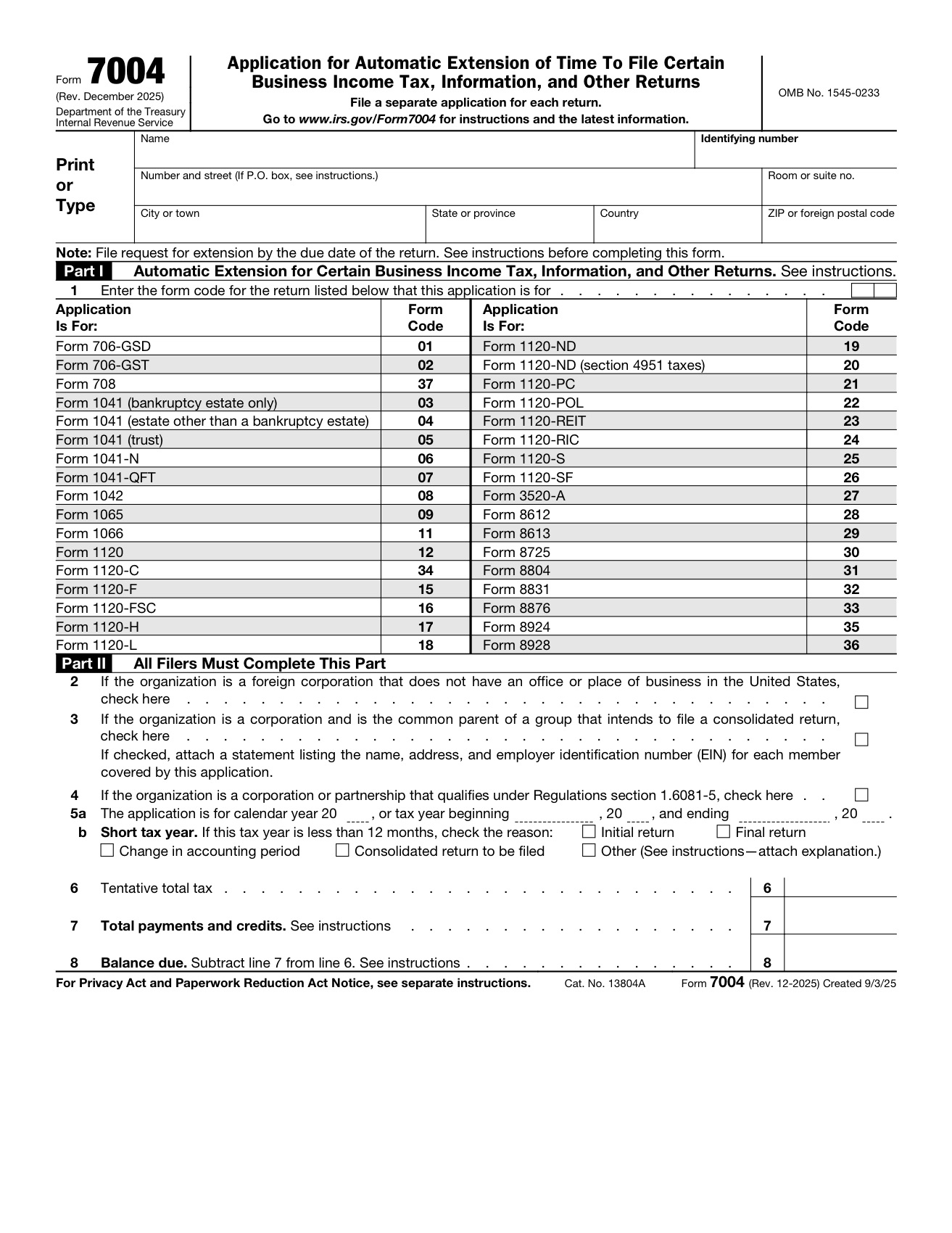
Form 7004 has three parts: the header (name, identifying number and address), Part I (one form code) and Part II (lines 2 to 8). Most businesses fill in the header, line 1, line 5a and lines 6 to 8, and leave lines 2, 3, 4 and 5b blank.
This guide covers the December 2025 revision, the current one.
Which version this covers
Form 7004 (Rev. December 2025), with the Instructions for Form 7004 (Rev. December 2025). The IRS form and instructions are on IRS.gov. We check for a new revision every January.
1. Name
Enter the name exactly as it appears on last year's return. If the name has changed since then, still use last year's name. If the name doesn't match the IRS database, or the identifying number is wrong, you won't have a valid extension.
2. Identifying number
Enter the employer identification number (EIN). The instructions also allow a Social Security number where that's the filer's identifying number. Write an EIN as nine digits, like 12-3456789.
3. Address
- Put the suite, room or other unit number after the street address, in its own box.
- Use a P.O. box only if the post office doesn't deliver to the street address.
- Outside the U.S. or its territories: enter the city, province or state, and country, in that order. Follow the country's practice for the postal code, and don't abbreviate the country name.
- A new address on Form 7004 doesn't update IRS records. Use Form 8822 or Form 8822-B to change your address.
4. Part I, line 1: form code
Enter the two-digit code for the return you're extending, one digit per box. The common ones: 09 (Form 1065), 25 (Form 1120-S), 12 (Form 1120), 05 (Form 1041 trust), 04 (Form 1041 estate) and 03 (Form 1041 bankruptcy estate). All 34 codes.
A homeowners association electing to file Form 1120-H uses the original form type assigned to the entity. A trust filing Form 1041-A uses Form 8868, not Form 7004.
5. Line 2: foreign corporation with no U.S. office
Check it only for a foreign corporation that doesn't have an office or place of business in the United States. That corporation files Form 7004 by the 15th day of the 6th month after the tax year ends.
6. Line 3: consolidated return parent
Check it if the corporation is the common parent of a group that intends to file a consolidated return. Only the common parent or agent can request the group's extension. Attach a list of every member with its name, address and EIN.
On a paper filing, the IRS specifies the format: 8.5 x 11, 20 lb. white paper; 12-point Courier, Arial or Times New Roman; black ink; one-sided; at least 1/2-inch margins; two columns (names and addresses on the left, EINs on the right, 1/2 inch apart); two blank lines between members. A member that isn't joining the consolidated return files its own Form 7004.
7. Line 4: Regulations section 1.6081-5
These entities already get an automatic extension to the 15th day of the 6th month without filing anything:
- Partnerships that keep their books and records outside the United States and Puerto Rico.
- Foreign corporations with an office or place of business in the United States.
- Domestic corporations that do business and keep their books outside the United States and Puerto Rico.
- Domestic corporations whose principal income is from U.S. territories.
They attach a statement to the return saying they qualify. If they need more time, they check line 4 to ask for an additional 3 months (partnerships and S corporations) or 4 months (C corporations and Form 1120-POL). That's more time to file, not to pay.
8. Line 5a: tax year
For a calendar year, enter the last two digits of the year. For a fiscal year, enter the beginning and ending dates instead.
9. Line 5b: short tax year
If the tax year is shorter than 12 months, check the reason: initial return, final return, change in accounting period, consolidated return to be filed, or other. A change in accounting period generally needs IRS approval first (Form 1128 and Publication 538). If you check "Other," attach a statement that clearly explains why the year is short. A corporation with a short year ending in June is treated as if the year ended June 30.
10. Line 6: tentative total tax
Enter the total tax, including any nonrefundable credits, that you expect to owe for the year. Use the instructions for your return to estimate it. If you expect zero, enter -0-. The IRS grants the extension only if you make a proper estimate.
11. Line 7: total payments and credits
Enter your payments and refundable credits for the year, such as estimated tax payments.
12. Line 8: balance due
Subtract line 7 from line 6. Form 7004 doesn't extend the time to pay: pay this amount by the original due date. Most entities pay by electronic funds transfer, generally through EFTPS. If you e-file Form 7004, you can pay by electronic funds withdrawal (Form 8878-A). How payment works.
Rounding to whole dollars
You can round to whole dollars. If you do, round everything: drop amounts under 50 cents and round 50 to 99 cents up ($1.39 becomes $1, $2.50 becomes $3). When adding several amounts, add with cents and round only the total.
No signature
Form 7004 doesn't need a signature.
Last reviewed: · Based on 2 IRS sources
Fill out Form 7004 free. No account, and nothing you type leaves your browser.